CustomersAT-06
SA
Support Agentsupport-agent-inbox
Drafts policy-based replies.
Drafts
For solo owners, small agencies and online sellers who already use Claude
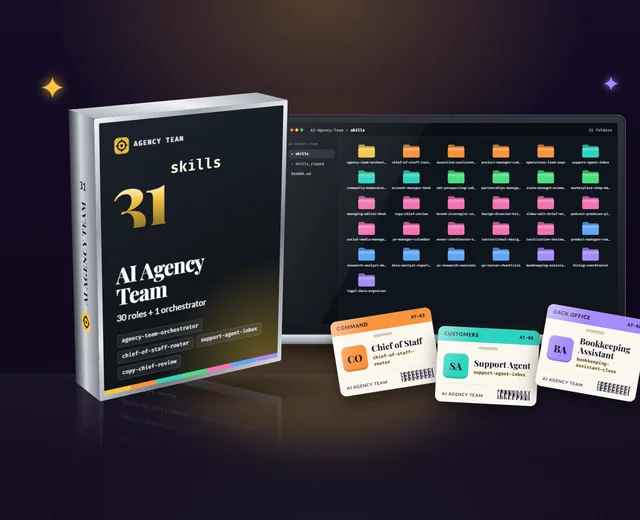
AI Agency Team is 31 Claude Agent Skills: 30 role skills (support agent, bookkeeping assistant, SDR, copy chief, project manager and 25 more) plus one orchestrator that routes your requests between them. Every role knows its routine, its deliverables, who it hands work to, and when it must stop and ask you.
Get the 31-skill team for $27 One-time payment · instant download through WarriorPlusDrafts policy-based replies.
Month-end close, no tax advice.
Sorts the pile. Routes it. Writes Friday's one-page rollup.
From: support-agent-inbox
To: product-manager-roadmap
Done when: decision loggedThe problem
You open a chat, explain your business for the fortieth time, get a decent answer, and close the tab. Tomorrow you start again from zero. Claude can write, sort, summarize and plan. What it doesn't have is a job description.
Hiring a chief of staff, a bookkeeper, a support agent and a project manager is out of reach for most one-person businesses. Writing 30 detailed prompts yourself is a project you'll never get to.
The reframe
A prompt says "write a reply to this customer." A role says: here's how we tag and prioritize tickets, here's the reply structure, here's when a refund goes to the owner as a decision memo, here's the weekly report you'll get on Friday, and here's who gets the bug report. That's the difference between asking someone a favor and giving them a job.
Each skill in AI Agency Team is written as a role. It has a role card (what it owns, its cadence, who it receives work from, who it hands off to, when it escalates to you), a step-by-step method, output templates, a fictional worked example and a final checklist. Claude loads the right one when your request matches it.
| A pile of prompts | AI Agency Team |
|---|---|
| One-off requests with no routine | Daily, weekly and monthly cadence per role |
| Every answer stands alone | Shared handoff note so work passes between roles |
| Claude guesses the format | Named deliverables: triage table, RAID log, AR aging, run sheet… |
| Re-explain your business each chat | One business profile + a TEAM_NOTES.md file every role reads |
| No idea where the line is | Each role lists what it must escalate to you |
| Paste, tweak, forget | Install once; Claude picks the matching role |
Meet the team
AI Agency Team turns Claude into a small staff you can direct. Start with the orchestrator: tell it what you sell, who helps you and your biggest bottleneck, and it suggests 3–5 starter roles, writes a TEAM_NOTES.md file for you to keep, and gives you copy-paste prompts to start each role.
Each of the 30 roles has a role card, method, templates, worked example and checklist, so its output looks like a professional deliverable, not a chat reply.
Every role uses the same handoff note, status report and labels ([DRAFT], [READY], [FYI]), so one role's output is the next role's input.
Roles draft. You approve. Money, contracts, legal or tax questions, hiring decisions and anything that can't be undone always come back to you.
The org chart
These are all 31 skills in the pack, grouped into the 6 pods the orchestrator uses. The small code line on each badge is the skill's real folder name.
Sets goals and approval rules. Signs off on money, contracts, hiring and anything irreversible.
Picks starter roles, writes routing tables and activation prompts, defines the shared conventions.
Sorts your pile, routes it to the right role, keeps the decisions log and writes the Friday rollup.
Inbox bins, drafted replies, scheduling messages, travel plans and a recurring-dates tracker.
Charter, task plan, RAID log, weekly status and change control for multi-step projects.
SOPs, process maps, root-cause notes, vendor scorecards, subscription audit, continuity sheet.
Tags the queue, drafts policy-based replies, calms upset customers, builds macros and help docs.
Rules with a consequence ladder, daily mod sweep, mod log, health report and crisis playbook.
Client health scores, update drafts, scope log and change orders, QBRs, renewals, recovery plans.
Daily prospecting rhythm: research, multi-touch cadence, reply handling, qualification, meeting handoff.
B2B partner pipeline (reseller, integration, bundle, licensing), fit scoring, partner reviews.
Own-site store ops: daily checks, catalog hygiene, reorder points, promo calendar, store KPIs.
Amazon/Etsy/eBay/Walmart ops: account health, listing issues, buyer messages, restock, appeal drafts.
Research plan, issue tree, graded sources, one-page brief, evidence table, weekly watch digest.
Cleans your CSV, defines metrics, explains what changed and why, writes the weekly KPI report.
Feedback themes, RICE scores, Now/Next/Later roadmap, one-page specs, release reviews.
Screeners, interview and usability guides, note grids, affinity synthesis, severity-rated issues.
Non-code QA: test plans, pre-launch checklists for funnels, stores, courses and PDFs, bug log, sign-off.
Categorized transactions, reconciliations, AR/AP lists, month-end checklist, accountant packet. No tax advice.
Role scorecard, job post, screening rubric, paid trial, interview kit, 30/60/90 onboarding.
Contract register, plain key-term summaries, renewal calendar, lawyer question pack. Not legal advice.
Each badge is one skill folder. Inside: a role card (what it owns, its daily/weekly/monthly cadence, who it receives work from, who it hands off to, when it must stop and ask you), a method, output templates, a fictional worked example and a final checklist. The AT number is its place in the team index.
Editorial pipeline, edit levels, assignment briefs, style guide, fact-check and refresh queue.
Final copy gate: rubric score, claims table, compliance sweep, approval log.
Positioning, brand architecture, naming screen, brand book outline, quarterly brand audit.
Creative briefs (with an optional AI-image prompt block), critique rubric, review rounds, file specs.
Edit briefs, paper edits, shot lists, timestamped feedback rounds, QC and export specs.
Season slate, guest booking and prep, run-of-show, show notes, chapters, repurposing list.
Weekly social ops: intake, approval states, scheduling QA, engagement shifts, monthly report.
12-month PR calendar, angle bank, media list, press kit, interview prep, crisis kit, coverage log.
Event brief, backward timeline, budget, vendors, minute-by-minute run sheet, wrap-up.
Course blueprint, objectives, lesson plans, quiz bank, project rubric, completion support.
Translation and review with glossary, style sheet, error typology, locale formats, cultural flags.
Not every business needs every badge. The orchestrator's rule of thumb: start with 3–5 roles linked to your real bottleneck. A role with no weekly routine gets forgotten.
See them work
Six of the thirty roles, with the situation each one is built for and the outputs its skill file names.
CSAT-02 · Chief of Staff
You type: your Monday brain-dump
SAAT-06 · Support Agent
You type: your policy + today's tickets
BKAT-08 · Bookkeeping Assistant
You type: your bank or marketplace export
CCAT-13 · Copy Chief
You type: the draft + where it's going
SDAT-10 · Sales Development Rep
You type: your ideal client + a lead list
LDAT-30 · Legal Docs Organizer
You type: your agreements (text or PDFs)
One full example
The request below is written for this page; the answer is the worked example from the orchestrator's own skill file, lightly trimmed. Maya is fictional. Your output will be built around your business, so it will look different.
Here's a starter team of four, linked to your two bottlenecks. Each has a routine, so none of them sits idle.
| Role | Pod | Owns | Routine | First task |
|---|---|---|---|---|
| chief-of-staff-router | Command | triage, priorities | daily 10 min; Friday rollup | sort her brain-dump list |
| support-agent-inbox | Customers | buyer messages, macros | daily queue | write 6 macros for top questions |
| project-manager-cadence | Command | bundle launch plan | Mon plan, Fri status | charter for the bundle launch |
| marketplace-shop-manager | Revenue | Etsy listings, health | daily check | review listing compliance |
Routing table: bundle launch. One owner per step, and the reviewer is always a different role.
| Step | Owner | Reviewer | Input | Output | Handoff to |
|---|---|---|---|---|---|
| 1 | project-manager-cadence | owner | goal, date | charter + task plan | copy-chief-review |
| 2 | copy-chief-review | owner | listing draft | approved listing [READY] | marketplace-shop-manager |
| 3 | marketplace-shop-manager | qa-tester-checklists | approved copy, files | live listing | support-agent-inbox |
| 4 | support-agent-inbox | owner | bundle details | FAQ + macros | — |
Next: a TEAM_NOTES.md starter for you to keep, and a copy-paste prompt to start step 1, for example: "Act as the project-manager-cadence role. Read the project-manager-cadence section of TEAM_NOTES.md first. Here is the handoff note: [paste]. Return a charter and task plan marked [DRAFT]."
Here's the support agent's own worked example (also fictional). Ana sells digital sewing patterns and doesn't refund downloads. A customer writes: "This is the THIRD time I've tried to print this and the sizes are all wrong. I want my money back." The support role tags it Complaint, P2, and drafts:
Task: review printing-scale complaints · Why it matters: top contact reason this week (11 of 38 tickets) · Definition of done: decision on adding a test square + print note · Approval needed: N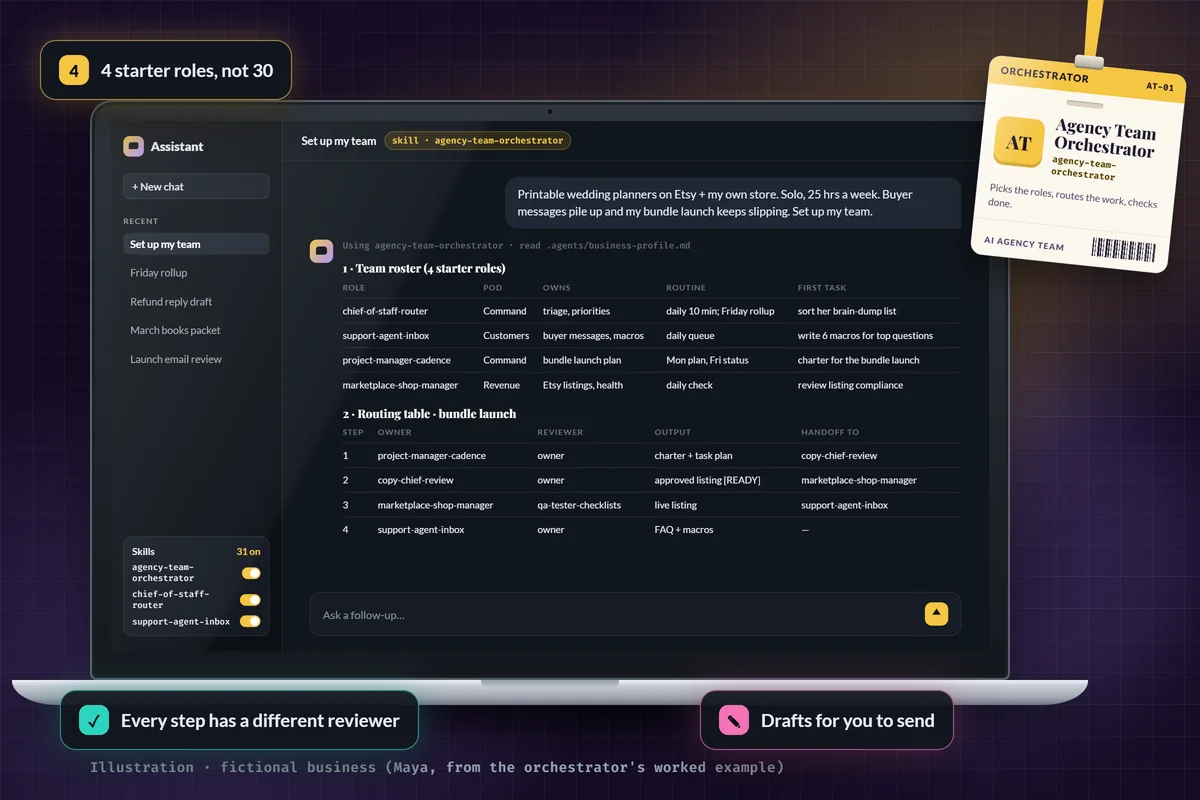
Illustration · fictional business from the orchestrator's worked example
House rules
A team falls apart at the handoffs. So every skill in the pack uses the same three conventions, defined once by the orchestrator.
Used whenever one role passes work to another.
From role:
To role:
Task:
Why it matters:
Inputs attached:
Definition of done:
Due:
Open questions:
Approval needed (Y/N):
Every active role files one on Friday; the chief of staff rolls them into one page.
Role / week of:
Done:
In progress:
Blocked (by whom):
Next:
Decisions needed from owner:
Plain markdown you keep and paste or attach in each role chat.
# TEAM_NOTES
## Business facts
## Voice
## Approval rules
## Decisions log
## (one section per role)
Read your section first.
Append dated entries.
Never delete another
role's entries.
[DRAFT]needs your approval[READY]approved, can be used or sent[FYI]no action neededAlways escalated to you: money movement, contracts, legal, tax or medical questions, public statements in a crisis, hiring and firing decisions, and anything that can't be undone. One honest note: Claude keeps no memory between chats unless you paste or attach TEAM_NOTES.md, or a memory feature is turned on. The file is how the team remembers.
How it works
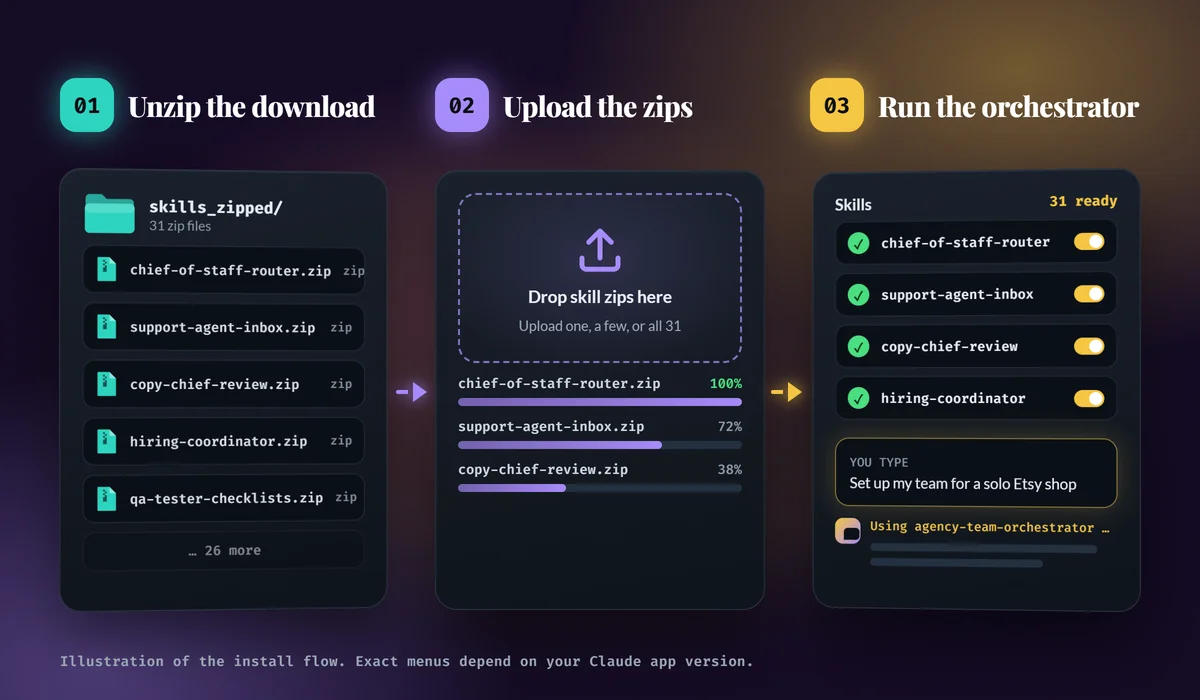
In Claude.ai, turn on Skills and upload the per-skill zip files from the skills_zipped/ folder (all 31, or only the roles you want). In Claude Code, copy the folders into your skills folder. The README walks through both.
Ask "set up my AI team." It reads or helps you create your business profile (.agents/business-profile.md) and a TEAM_NOTES.md, then suggests 3–5 starter roles for your bottleneck.
"Sort my week." "Answer these tickets." "Prep March for my accountant." Claude loads the matching role, follows its method and returns the deliverable, labeled for your approval.
Tip from the orchestrator: one role per chat thread keeps context clean. The chief of staff stitches the threads together on Friday.
Fit check
Also in the box
No made-up bonus values. These are the real files that come with the pack.
Step-by-step setup for Claude.ai (upload per-skill zips) and Claude Code (copy folders), plus how to fill in your business profile.
One zip per skill in skills_zipped/, so you can add roles one at a time as you need them.
The team memory template from the orchestrator: business facts, voice, approval rules, decisions log and a section per role.
12 of the roles ship with extra reference files, such as a month-end close checklist, pre-launch QA checklists, an SOP template, a PR crisis kit, a one-page spec and buyer-message templates.
Monday plan, daily triage, Friday reports, monthly close, quarterly goals: which role does what, when. Adopt it as is or let the orchestrator adjust it to your hours.
Your license
Included with the $27 front-end purchase.
Everything you get today
30 role skills + 1 orchestrator for Claude
$27one-time payment
Secure checkout through WarriorPlus · instant download · 30-day refund by emailThe guarantee
Install the orchestrator tonight and let it pick your starter roles. Hand the chief of staff your messy Monday list. If the team isn't useful to you, email puzzleink.help@gmail.com within 30 days of purchase and you'll get a full refund. No forms, no hoops.
Questions
A skill is a folder with a SKILL.md file (and sometimes reference files) that tells Claude how to do a specific job: when to use it, what to ask you, the method, the output templates and the checks. Claude loads a skill when your request matches it. Each skill here is written as a team role.
A Claude plan that includes Skills (check Claude's current plan features, since they change), or Claude Code. No other software, no API keys and no coding. You upload the zips in Claude.ai or copy the folders in Claude Code.
Yes. You talk to the roles in plain English ("sort my week", "answer these tickets"). The README covers installation step by step. If you get stuck, email support.
No. The skills are instructions; they don't send, post, pay or log into anything. They produce drafts, tables, plans and checklists labeled [DRAFT] for you to approve and use. If you've connected tools to Claude yourself, the roles still default to drafts for a human to send.
Claude keeps no memory between chats unless you paste or attach your files or a memory feature is on. That's why the pack uses a shared business profile and a TEAM_NOTES.md file: each role reads its section first and appends dated entries.
No. The bookkeeping assistant categorizes, reconciles and prepares a packet; tax questions are logged for your accountant. The legal docs organizer builds a register, plain summaries and a question list for your lawyer, and every sheet says it's for organization only. Neither is tax, legal or financial advice.
No. Most people start with the orchestrator plus 3–5 roles. Each skill has its own zip, so you add roles when you need them.
The skills are built and tested as Claude Agent Skills. They're plain text, so you can read them anywhere, but other AI tools aren't supported.
The $27 license covers your own business. Delivering paid client work with the skills needs the optional Agency License, and selling the pack as your own needs the optional Resell Rights. Both are offered after checkout.
Yes. After checkout you'll see 2 optional upgrades. Agency License ($37): use the skills to deliver paid work for clients, plus a client-ready kit (proposal, scope and report templates). Resell Rights ($47): sell the front-end pack as your own, with a ready reseller sales page and 5 promo emails. Both are optional; the team works fully without them. Each has a plain "no thanks" link.
There's no guarantee of income or results. The roles help you organize and draft the work; what happens depends on your business, your market and what you do with the output.
No. Claude is a trademark of Anthropic; this product is not made or endorsed by Anthropic. It's an independent pack of skills by LeoHa.
Email puzzleink.help@gmail.com within 30 days of purchase with your order email or receipt, and you'll be refunded in full through WarriorPlus.
Your move
You don't need a payroll to run like a team. You need roles that know their routine, one place where decisions are written down, and a clear line for what comes back to you. That's what these 31 skills are.
Yes, staff my business for $27 One-time payment · 30-day refund · Claude.ai + Claude CodeP.S. You don't have to set up all 30 roles. Install the orchestrator and the chief of staff, paste in your Monday list, and see what comes back.
P.P.S. If it isn't useful within 30 days, one email to puzzleink.help@gmail.com gets you a full refund.